


LAPEER, Mich. — Lapeer City Commissioner Stefan Brady spent about three months in 2025 trying to become eligible for a federally funded home-rehab grant the city administers. The effort ended with a June 10, 2025, opinion from City Attorney T. Allen Francis that Brady, as an elected official, could not receive the grant unless HUD or MSHDA granted an exception.
Emails, minutes, and a memorandum obtained under FOIA show the rest.
The records show Brady voted in March 2025 to authorize the city’s application for the grant, asked the city manager three weeks later whether recusing himself would make him eligible, was warned by the manager not to pursue it before he abstained from a second vote in April, then a few days later submitted a written request to the city manager that the city attorney prepare a statement supporting an exception to federal conflict-of-interest rules. The city manager forwarded the request to the attorney the following day without a vote of the commission.
A week later, a three-page legal opinion, dated June 10, 2025, written by the city attorney at taxpayer expense, was included in the agenda package for the next meeting.
Brady did not ultimately apply for the grant.
On July 20, 2026, after two members of the public, including John DeAngelis, mentioned his prior efforts to get a legal opinion granting him an exception, Brady requested during public comment time if he could step to the podium and deliver his own public comment, “I refute the claims brought by this gentleman… the city incurred no billable expense from me, you can check if you want… That’s slander. It’s a lie. It’s a blatant — they know, they FOIA’d the information.”
Brady continued from the public podium, “Those two gentlemen just stood up here and lied purposely on me. Am I gonna litigate and chase them down? No, it’s called grace. It’s fine.”
Brady’s claim that the city incurred no billable expense is contradicted by the city’s actual record. Mayor Jeramy Hing told Lapeer First News (LFN) that city records show the city was billed by the city attorney for that written legal opinion, an expense never approved by the commission.
When Hadley resident John DeAngelis issued a FOIA request for these documents, the city failed to provide a handful of key emails that fell under the request. Mayor Jeramy Hing published these documents on his website as part of the fulfillment of his campaign promises for accountability and transparency.
The grant
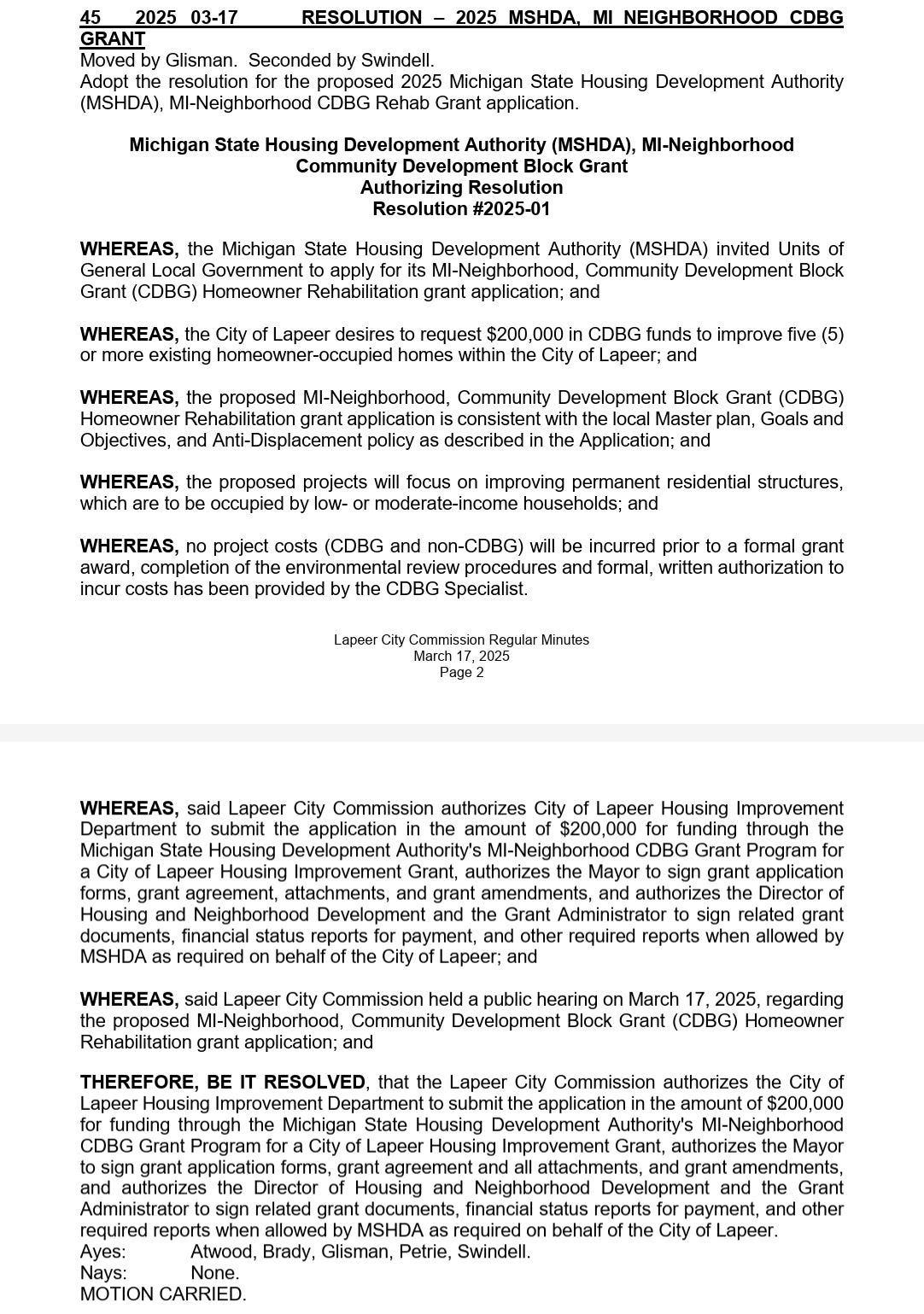
On March 17, 2025, the commission voted 5-0 to adopt Resolution 2025-01 authorizing the city’s Housing Improvement Department to apply for $200,000 through the Michigan State Housing Development Authority’s MI-Neighborhood Community Development Block Grant program.
According to the resolution, the money was to improve five or more owner-occupied homes in the city occupied by low- to moderate-income households. The purpose of the grants is to help low- and moderate-income homeowners make emergency repairs to their homes that they cannot afford, especially when there is an immediate threat to health or welfare. Eligible participants are awarded on a first-come, first-served basis.
The minutes record Brady voting in favor.
“Please advise”
On April 16, 2025, Brady emailed City Manager Mike Womack under the subject line “Mi-Neighborhood.”
“I am wondering if I were to recuse myself from this if I would then become potentially eligible for the grants (under the understanding that last year I was excluded from consideration due to having voted favorably on this grant),” Brady wrote. “Sorry, its late notice, but I didn’t know it was coming on this agenda until now.”
Womack replied April 21, copying city attorney T. Allen Francis of Fletcher Fealko Shoudy & Francis in Port Huron. Womack wrote that he was not aware of anything specifically prohibiting Brady from eligibility, though the grant rules might exclude him, and that he could not think of any circumstances that would create good optics for an elected official obtaining a grant facilitated by city staff.
“My recommendation would be to not apply for this grant, or any grant that City staff work on obtaining, regardless of whether you might be legally eligible for it or not,” Womack wrote. If Brady was determined to apply anyway, Womack recommended he recuse himself from any vote on the grant, state his intention to apply, and include a written request with his application that he be awarded funds only as a last resort after all other eligible applicants.
That evening, the commission took up a revised authorizing resolution, Resolution 2025-07, for the same $200,000 application. The minutes record four ayes and one abstention: Brady.
Brady explained his abstention by saying, “I would seek to preclude myself from voting on this, um, with the intention of applying for it, you know, saying, put my name at the very end of the list. I understand there is a conflict of interest that could be there, um, I don’t even know if I’m going to or not, but I couldn’t vote on it now and then if I investigate it later and then decide to, um, so…”
The request
On April 26, five days after he abstained, Brady emailed Womack a memorandum titled “Clarification of City Commissioner Status and Request for HUD Conflict of Interest Exception – MI Neighborhood CDBG Rehab Grant Application.”
The email asked Womack to direct the city attorney to prepare a written statement that Brady was an elected officer rather than a city employee, that identified the conflict, that confirmed he had recused himself “from voting on all matters involving the CDBG grant application or award process,” and that gave a legal opinion that his participation, if HUD approved an exception, would not violate state or local law. He also asked the city to submit a conflict-of-interest exception request to HUD.
“I am seeking no preferential treatment but merely requesting the ability to apply for housing rehabilitation assistance on the same basis as any other qualifying low- to moderate-income household,” Brady wrote. He stated his 2024 household income as filed with the IRS, claiming it fell within the program’s limit.
Womack forwarded the email to housing staff on the morning of April 28. Grant administrator Shelley Lincoln replied that once the city attorney responded, she would outline next steps on the grant agreement.
Denise Soldenski, writing 33 minutes later, said Brady “should be able to apply,” but she questioned whether the city should seek a legal opinion before his eligibility was verified through the grant process.
“He may be over-income as we calculate gross income for grant eligibility, and current wages, etc. may be more by the time we are ready to send out applications,” Soldenski wrote. She noted the city still needed a grant agreement and an environmental review before funds could be released, and she asked that Brady be added to a waitlist Lincoln was already keeping “so that he gets an application along with other residents who have requested, in advance.” She then asked Womack whether to wait for a completed application or “get the legal opinion started per Commissioner Brady’s request.”
The commission did not take up that request in April. At the June 2 meeting, during commissioner comments, Brady said he had been researching the grant and “I’ve sent something to the mayor asking for an attorney letter. I would hope to see that come before the commission at some point.”
The referral
Womack did not wait for a completed application or board approval. On June 3, the morning after Brady raised the letter on the dais, he forwarded Brady’s April 26 memorandum to Francis, copying Soldenski.
“As you heard Mr. Brady mention during last nights meeting, he wants your opinion about whether he is eligible for the CDBG grant for rehabbing his home,” Womack wrote. He said MSHDA appeared to take the position that city employees were not eligible, that Brady was “trying to differentiate himself from being an employee so that he is eligible,” and that MSHDA would leave the determination to the local city attorney.
“This question obviously puts myself and staff into a tough position with an elected official so I would like your input about whether he is eligible for this Rehab grant or not prior to staff taking any action,” Womack wrote.
There is no record of a commission vote to approve the legal expense.
The opinion
Francis responded in a memorandum to Womack dated June 10, 2025, later included in a commission agenda packet as Item H-1.
Citing MSHDA’s program guide and federal regulations, Francis wrote that the conflict-of-interest prohibition covers any elected official of a local government receiving CDBG funds and “applies regardless of whether or not a ‘Persons Covered’ actually participates in the decision making or gains inside information.” The rule applies to anyone in a position to do so, he wrote.
“I have no reason to believe Mr. Brady has inside information or would participate in the process, but I believe he is in a ‘position to’ do those things,” Francis wrote. “Therefore, unless an exception to the rule applies, he is not eligible for a CDBG Grant.”
Turning to Section 5.12 of the city charter, which bars elected and appointed officials from taking official action on any contract or matter in which they are financially interested, Francis wrote that a CDBG award would create a contract between the city and the recipient, but that Brady would not violate the charter if he abstained from all action on the program.
The legal opinion did not mention Brady’s March 17 vote.
Francis concluded that the city could submit an exception request to MSHDA if the commission approved doing so, but offered his own assessment of how one required factor, the public interest, would weigh.
“In my opinion, allowing elected officials to apply for / receive CDBG Grants would have a negative effect on public interest,” Francis wrote. “Although Mr. Brady would not participate in the process, there would be the appearance of favoritism if he were awarded the grant.” He added: “Absent MSHDA or HUD granting an exception, Mr. Brady is not eligible.”
Brady declined to comment for this story.
Womack is no longer city manager. He was placed on leave in July 2026 during a city investigation of complaints that included sexual harassment and threats of retaliation against city employees, and he resigned while that investigation was pending. Finance Director Kelly Hanna was paid an acting-manager stipend covering the leave. LFN will report separately on that investigation.
Timeline
Mayor Hing provided this timeline on his website:
March 17, 2025 — After a public hearing, the Commission adopted Resolution #2025-01 (Motion 45) authorizing the City’s $200,000 MI-Neighborhood CDBG homeowner-rehabilitation grant application. Brady voted in favor. The commission action can be viewed on the meeting video, where Brady participated in the vote.
April 16, 2025 — Brady asked the City Manager whether recusing himself would make him eligible to apply, noting he had been excluded a prior year after voting favorably on the grant.
April 21, 2025 — The City Manager recommended Brady not apply, citing the optics of an elected official obtaining a grant facilitated by City staff.
April 21, 2025 (regular meeting) — The Commission re-adopted the application as Resolution #2025-07 (Motion 72); Brady abstained.
April 26, 2025 — Brady emailed a request for a City Attorney opinion and a HUD conflict-of-interest exception under 24 CFR § 570.611(d), disclosing his household income.
April 28, 2025 — Community Development staff noted he might be over-income, recommended waiting for a completed application before seeking a legal opinion, and added him to the grant waitlist.
June 2, 2025 (regular meeting) — In commissioner comments, Brady said he had been researching the grant and would need a letter from the attorney to proceed.
June 3, 2025 — The City Manager forwarded the request to the City Attorney for an opinion, noting it put staff in “a tough position with an elected official.”
June 10, 2025 — The City Attorney concluded that Brady, as an elected official, is a “person covered” under the federal CDBG conflict-of-interest rules and is ineligible to receive the grant absent an exception that only HUD or MSHDA, not the City, can grant.
June 16, 2025 — The opinion was included in the public meeting packet under the City Manager’s Report (agenda item H-1).
Disclosure: Scott McMahan is a Lapeer County commissioner. The county administers CDBG funds, and he has voted on those applications. Mayor Jeramy Hing identified emails omitted from a city FOIA production; those emails are cited in this article.


